Are PMMA butt injections safe? What to know before and after
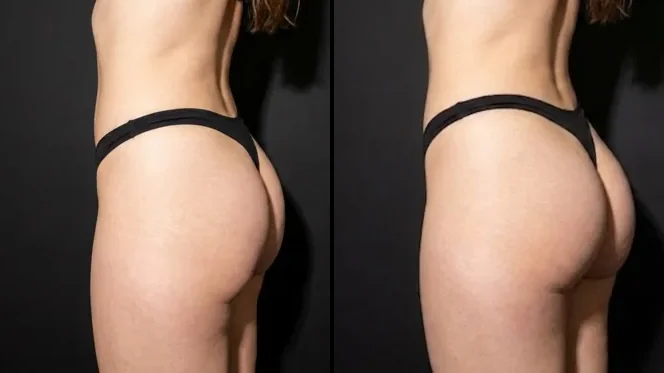 BeforeAfter
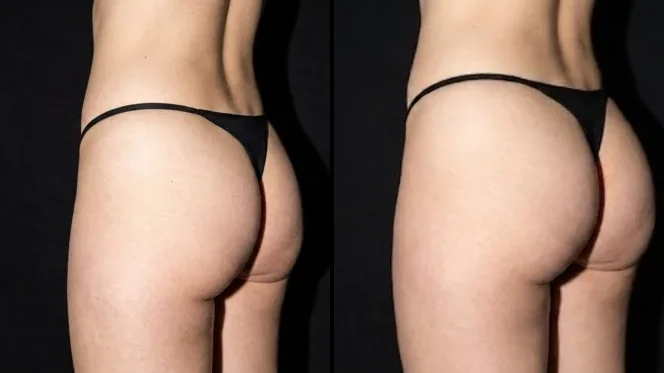 BeforeAfter
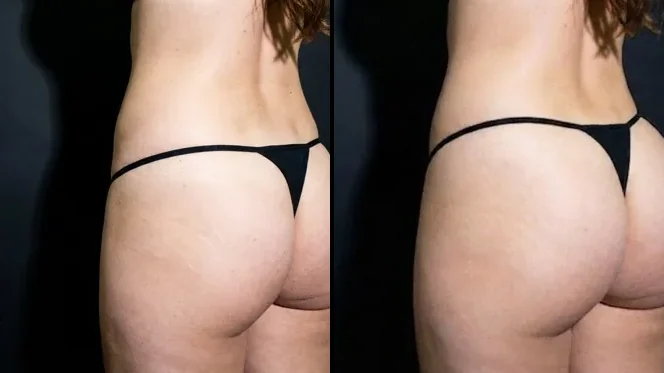 BeforeAfter
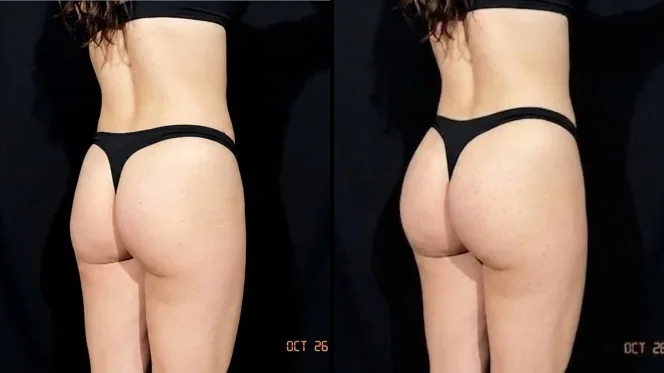 BeforeAfter
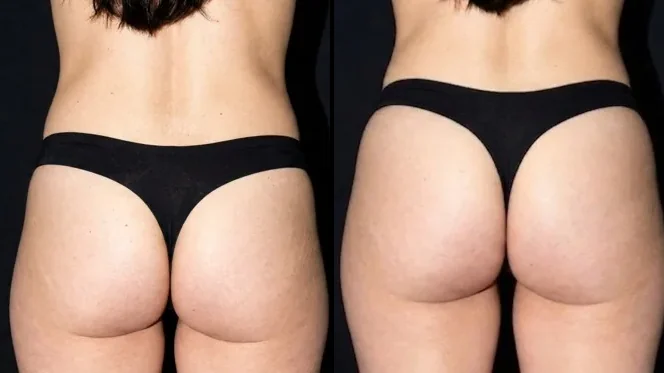 BeforeAfter
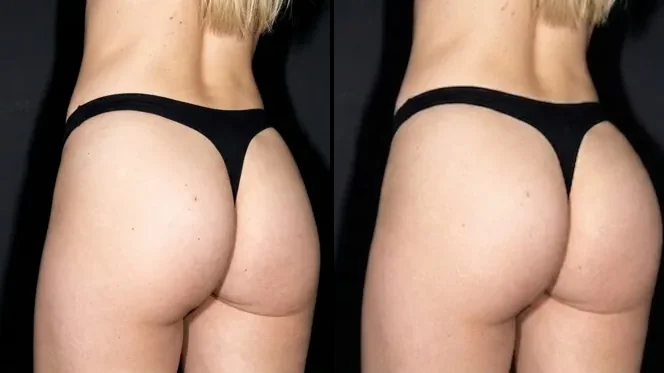 BeforeAfter
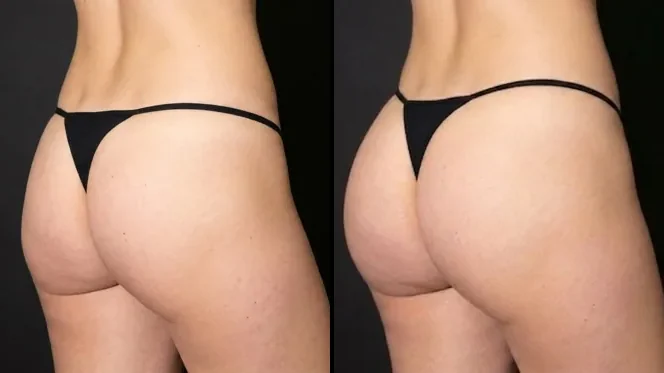 BeforeAfter
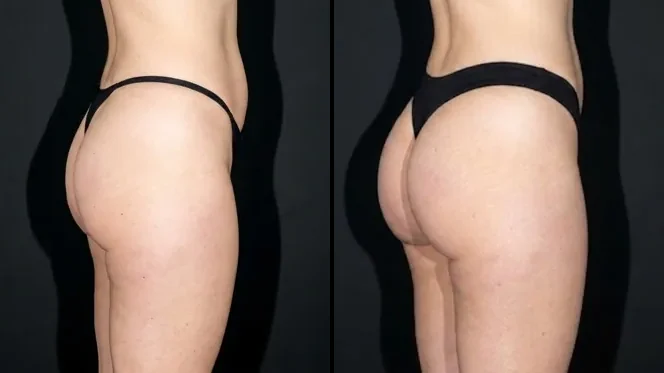 BeforeAfter
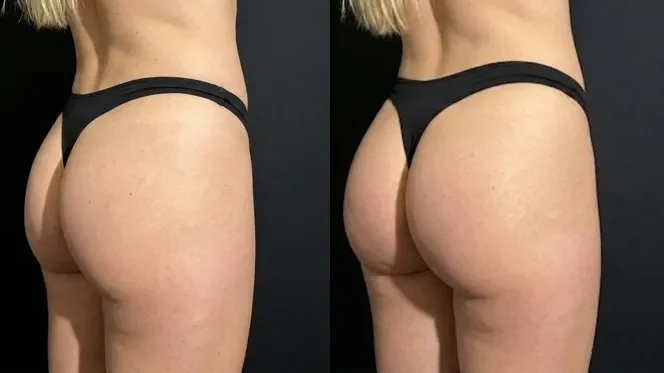 BeforeAfter
Each case is individual and results vary from person to person.
Dr. Thiago Perfeito does not use PMMA in any butt filler. The reason: PMMA stays in the body forever, no substance exists that dissolves it, and, if a reaction arises, removal is surgical and almost always incomplete. His buttock filler is done with absorbable products — body hyaluronic acid, a biostimulator, or your own fat — with the box opened in front of you.
What is PMMA, and why is it different from the other products?
PMMA stands for polymethyl methacrylate, a type of acrylic plastic. In aesthetic use, it comes as microspheres suspended in a gel. The body absorbs the gel in a short time; the microspheres, it does not. They remain in the tissue, and the body reacts to each of them as a foreign body, wrapping them in fibrous tissue. It is this buildup of internal scarring that produces the volume.
The products Dr. Thiago uses work differently. Body hyaluronic acid takes up space and is reabsorbed little by little. A biostimulator stimulates your own collagen and is broken down by the body over time. Your own fat is your tissue, transferred from one area to another. The difference that matters most for your safety is in the last column of the table: what to do if something does not go as planned.
| Product | Does the body absorb it? | Can it be undone? |
|---|---|---|
| Body hyaluronic acid (UPmax, Sofiderm) | Yes, gradually | Yes: hyaluronidase is an enzyme that breaks down the product |
| Biostimulator (Radiesse, made of calcium hydroxylapatite; Sculptra, made of poly-L-lactic acid) | Yes, over months | There is no agent equivalent to hyaluronidase; the body eliminates the product over time |
| Your own fat (Lipocube) | Part of the grafted fat takes and part is reabsorbed, depending on each patient | It is your tissue; there is no foreign product to remove |
| PMMA | No. The microspheres stay forever | There is no antidote; removal is surgical and partial |
To better understand the first two options, see hyaluronic acid or biostimulator.
Why does Dr. Thiago not use PMMA butt injections?
The appeal of PMMA is its permanence. The problem is that the same permanence applies to any complication. With an absorbable product, the worst-case scenario has an end date. With PMMA, it does not.
The medical literature describes reactions that appear months or years after the injection, when the patient no longer even associates the symptom with the procedure:
- granulomas — inflammatory lumps that grow slowly under the skin and deform the contour;
- migration of the material away from the point where it was injected;
- late infections, which can arise without a wound or evident cause and resist ordinary treatment;
- in large body volumes, as in the buttocks, changes in blood calcium and kidney injury.
None of these situations has a medication that removes the product. That is why his choice is to work only with absorbable material: accepting that the result needs maintenance, in exchange for always having a way out.
One clarification about the rules is in order. There are PMMA fillers registered with Anvisa, the Brazilian health regulatory agency; registration authorizes the sale of the product, but it does not make any volume, in any region of the body, safe. And since June 2, 2026, Resolution No. 2,461/2026 of Brazil's Federal Council of Medicine (CFM) prohibits physicians from using PMMA as a filler, whether aesthetic or reconstructive — the only exception is lipodystrophy in people living with HIV/AIDS, within the public health system (SUS).
I already have PMMA in my butt. Can I get butt filler?
Say so right at the start of the consultation. The presence of PMMA changes the plan, and the approach depends on your case, examined in person. It helps a great deal to bring whatever you have:
- the name of the product, if you know it;
- the approximate date of the injection;
- the quantity, if anyone told you;
- who injected it and where.
If you do not know exactly what you received, say that as well. It is a common situation, and it is better to state the doubt than to leave it out.
Even with no intention of having a new procedure, seek medical evaluation if a new lump, hardening, redness that comes and goes, or pain appears in the area. In someone with a large volume of PMMA in the body, excessive thirst, urinating a lot, nausea, constipation, unusual tiredness, or mental confusion call for a medical visit with calcium and kidney function tests.
How do I know which product was used on me?
Every legitimate injectable product has a brand name, a lot number, and an expiration date, printed on the box and on a traceability label. It is this label that makes it possible to know, years later, exactly what went into your body.
In Dr. Thiago's practice, this does not depend on you asking: the product box is shown and opened in front of you, and all the lot labels are affixed to your chart. That way there is a record, in your chart, of what was injected into you.
If you had the procedure done elsewhere, ask the provider for this information in writing: brand name, lot, and volume in mL or number of boxes. One detail that confuses many people is that the name does not reveal the molecule. UPmax and Sofiderm, for example, sound like biostimulators, but they are hyaluronic acid. Knowing the correct class changes what can be done in an emergency.
And if the clinic is unwilling or unable to say what it injected, consider that a warning sign in itself. In the guide on how to choose a doctor, identification of the product is one of the five criteria.
What are the warning signs after butt filler?
In the first days, it is expected to feel soreness similar to that of a heavy workout, swelling, bruising, and a feeling of heaviness when sitting. What defines whether everything is fine is the direction: these symptoms improve a little each day.
Contact the physician who injected you immediately if you notice:
- pain that increases instead of decreasing, especially after the first 48 hours;
- skin that is pale, purplish in a net-like pattern, darkened, or colder than the rest of the buttock;
- sudden, very severe pain during the injection itself;
- warm redness that spreads beyond the treated area, any discharge, or fever;
- a hardened area that grows, or a painful nodule that appears after everything had already improved.
Coughing up blood, shortness of breath, chest pain, or mental confusion are an emergency: go straight to an emergency room. And, for the signs above, if the physician does not respond right away, the route is also the emergency room, without waiting for a reply to a message. Bring the information on the product, the volume, and the date.
The step-by-step of aftercare is in butt filler recovery.
What makes butt filler safer?
No procedure is free of risk, but some factors greatly reduce the chance of a problem and improve the response when one happens:
- a physician with an active CRM (Brazilian medical license), who examines you in person before any proposal;
- an absorbable, identified product, with the lot recorded in your chart;
- correct technique and injection plane: the gluteal vessels lie in the deep planes, under the muscle, so where and how the product is deposited is not a detail;
- follow-up afterward: Dr. Thiago personally and closely follows any complication in his patients;
- a volume compatible with your body, defined at the consultation — see how many mL.
Dr. Thiago has more than 500 buttock cases and sees patients at Clínica INTI, in Lago Sul — details in where to have it done in Brasília. For the full overview of the procedure, start with the butt filler guide.
Frequently asked questions
Is PMMA banned in Brazil?
Can PMMA be removed?
Is body hyaluronic acid safer than PMMA butt injections?
Does a biostimulator have an antidote?
I have PMMA and I want more volume. What should I do?
How do I check the product on the day of the procedure?
When should I go to the emergency room?

The physician
Who writes this guide — and performs the procedure.
Dr. Thiago Perfeito is a physician (CRM-DF 23199) working in Aesthetic and Regenerative Medicine, with more than 500 buttock cases. He sees patients at Clínica INTI, in Lago Sul.
- The product boxes are shown and opened in front of you.
- The lot labels are affixed to your chart.
- Every complication is followed up by him, in person.
Your assessment starts with a conversation.
At the in-person assessment, the technique, the product and the volume for your case are defined. Clínica INTI, Lago Sul — about 15 to 20 minutes by car from Asa Sul.